How Long Do Turkey Teeth Last?
Aesthetic dental treatments performed in Turkey, particularly veneer and crown applications, have become quite popular in recent years. For this reason, these treatments have come to be known as ‘Turkey teeth’. However, patients seeking treatment have begun to wonder about the lifespan of Turkey teeth.
Turkey teeth treatments generally have a lifespan of more than 10 years. It is not correct to specify an exact time for any dental restoration. This is because the durability of a restoration is influenced by many factors, such as how the tooth is prepared, gum health, the patient’s bite, the bonding materials used, and long-term care habits. In this article, we will explain the average lifespan of restorations, how to extend it, and which factors determine the durability of a restoration.
How long do Turkey teeth last on average?
Longevity of veneers and crowns
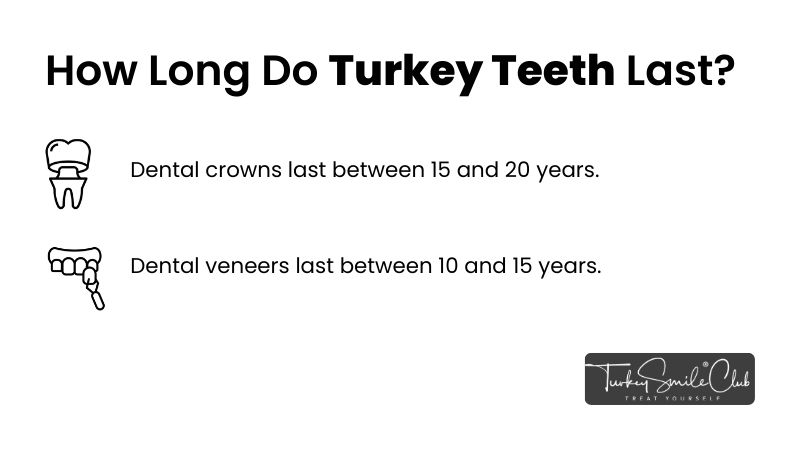
The average lifespan of veneers in Antalya is between 10 and 15 years. High-quality ceramics such as E-max veneers have properties similar to natural tooth enamel. As veneers are thin structures, they must bond strongly to the enamel surface.
The average lifespan of crown treatments is between 15 and 20 years. Zirconia and E-max crowns are highly durable. Zirconia crowns is a stronger material, making it suitable for teeth in the back regions. E-max crowns, on the other hand, offer an aesthetic advantage in the front regions due to their more natural light transmission.
Longevity Full mouth restorations
In full mouth restorations, i.e. veneer and crown procedures performed throughout the entire mouth, the lifespan is 15 years or more. If the bite is balanced, the material selection is correct, and the load distribution of the restorations is well designed, this period can be extended further.
The most important factor in full mouth treatments is the correct analysis of jaw joint movements and upper–lower jaw occlusion. Incorrect occlusion can lead to premature fractures or wear.
What affects the lifespan of Turkey Teeth?
Gum health
Gum health is one of the key determinants of Turkey teeth procedure. Gum recession causes the edges of crowns to become exposed and the underlying natural tooth to decay. In patients with good gum health, the lifespan of restorations increases significantly because their edges remain sealed for a long time. For this reason, any gum problems should be controlled before Turkey teeth treatment.
Bite problems (bruxism, overbite, crossbite)
Bruxism, or teeth grinding or clenching, is one of the most common causes of damage to restorations. Forces exerted during the night in particular can be three to four times greater than natural chewing forces. This can lead to problems such as cracking, chipping, and wear on veneer or crown surfaces.
In cases of malocclusion such as overbite or crossbite, chewing forces are not distributed evenly, causing restorations to wear out prematurely. The use of night guards is highly valuable for protection in these patients.
Material quality
The quality of the material used affects the longevity of the treatment. There are many brands that provide veneers and crowns. Dentists in Turkey work with international brands for Turkey teeth.
Adhesive techniques and cement quality
How well restorations bond to the tooth significantly affects their lifespan. New generation resin cements maintain both durability and colour stability. If the bonding protocol is not followed correctly, even the highest quality material may fall out over time or leak at the edges. For this reason, whether you are in the UK or Turkey, seek out a good dentist.
Patient lifestyle factors (Grinding, smoking, diet, poor oral hygiene)
Teeth grinding, smoking, a high-acid diet, poor oral hygiene, and irregular check-ups shorten the lifespan of restorations. Habits such as flossing, regular cleaning, wearing a night guard, and avoiding hard foods significantly extend the lifespan of restorations.
Individuals who use Turkey teeth for a long time pay attention to gum health, regular dental check-ups, and oral hygiene. The combination of these factors ensures that restorations remain strong and aesthetically pleasing for many years.
FAQ
Are Turkey teeth permanent?
Turkey teeth are not permanent. The mouth is a structure that changes with age. Gums may recede over time, jaw relationships may change, and adhesives weaken over the years. Therefore, it is natural and expected that restorations need to be renewed at certain intervals. Ten years after dental work in Turkey, minor adjustments or polishing may be required. After 15 years, most restorations approach the renewal process. A 20-year lifespan is possible for patients who maintain ideal care.
Do Turkey teeth last shorter or longer than UK treatments?
The lifespan of restorations performed in Turkey is the same as those performed in the UK. Turkey teeth treatment is performed by Antalya’s best dentists. The materials used are sourced from world-renowned brands. For this reason, Turkey teeth are extremely high quality and long-lasting.
For more detailed information about Turkey teeth and to receive your dental treatment without waiting in line, please contact us.